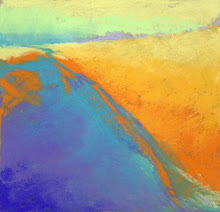
At a recent gallery talk I was asked: What inspires you? A very common question at a gallery talk! I was surprised to find myself momentarily stumped. I had never thought about! I just love to paint. My answer was: "I just really love the physicality of rich, juicy oil paint and the way it reponds on the canvas, or panel, or paper. It doesn't seem to matter what I paint. It's the joy of doing it that drives me."
Hmmm. So I've been thinking about that ever since. Then I read a Painter's Table interview with artist Joanne Greenbaum . She says:
"Inspiration is not a real word for serious artists, they don't get
'inspired,' they just work. Ideas come from actually working for me, so
even if I have an upcoming show, my work may be more intense but all in
all, I keep regular hours each day, working until I am tired. ...I am one of those people that likes to work with no goal or specific
ideas in mind, I like to just play with my materials and something
always interesting comes of that."
What she said really rang true for me. It felt good to know that such an accomplish painter also worked that way. When I play with my paint something interesting usually comes from it. If I start with a kernel of an idea, it is usually evolves into something completely different. Even painting outdoors, I start painting a view but then lose track of any specifics and let the painting take over. Even those familiar with the location are often hard-pressed to identify the spot.
I'm motivated by the inner feeling of joy doing it, rather than inspired by some influence outside of me.
Painting above: These rocks, they whisper to me, 19 x 25", oil on yupo. Painting en plein air at Stonington, Maine's Sand Beach.
Showing posts with label art process. Show all posts
Friday, September 27, 2013
Monday, May 30, 2011
Not Representing Anything
I enjoyed a brief little article in ArtSlant about painting abstract works (link below). It may be especially interesting to people who find abstract work intimidating because there appears to be nothing concrete to get one's head around...to understand. But this article points out that even when the artist tries to be completely abstract there is always an element of "representation" meaningful to the artist...even if he doesn't realize it is happening. We paint who we are, can't help it. Likewise, the viewer can choose to interpret the work in response to his own life experience. It becomes an interactive experience from all perspectives.
ArtSlant: On Not Representing Anything
The painting above is an abstract work done progressively by 5 different painters in one of my Tao of Painting Workshops. The paper had marks on it to start and each painter took a turn at responding to what was in front of her, so there are 5 personal commentaries in this work.
What does it communicate to you?
ArtSlant: On Not Representing Anything
The painting above is an abstract work done progressively by 5 different painters in one of my Tao of Painting Workshops. The paper had marks on it to start and each painter took a turn at responding to what was in front of her, so there are 5 personal commentaries in this work.
What does it communicate to you?
Sunday, April 10, 2011
Painting with Abandon at the Tao Workshop
The Tao of Painting Workshop yesterday was such fun. Lots of energy with everyone looking to work with the natural flow of creating art works. The morning was spent working in group exercises designed to relieve all painters of the potential for judgment and comparison, the fear of the blank canvas, and rules. For the paintings shown here, each participant was given a sheet of multi-media board that had random painted marks (each board different). They were instructed to focus, react and respond to the marks presented with their own addition of color, line, or texture in any medium. A variety of painting tools and media were available and had been experimented with in an earlier exercise. After +/- 5 minutes of work, the boards were passed to the painter to the right, and this "round" continued until each board had been worked on by each painter. We all liked the results of this particular exercise so much that we decided to donate the set of 5 to the Bangor School Department fundraiser for Japan relief. Kal Elmore, a workshop participant and art teacher at Bangor High is facilitating this donation. Participating painters in addition to Kal: Christine Swersey, Deb Jellison, Linda Miller, and Darlene Smith.
The afternoon was spent applying the experiences from the morning exercises...painting intuitively...to a still life, and finally to a work from memory or imagination.
Saturday, April 2, 2011
Tao of Painting Workshop, Saturday April 9
![]() |
| DreamWork 24" x 18" oil on panel |
We will explore ways for the painter to work past these barriers toward a more natural, responsive, expressive process, and find the balance between playfulness and skill. When it works, painting becomes a vibrant and powerful experience.
Tao: the art or skill of doing something in harmony with the essential nature of the thing; the process of nature by which all things change and which is to be followed for a life of harmony.
This workshop is for painters of any level and in any medium, however I recommend quick drying media such as watercolor, acrylic, gouache and pastel. Mixing media will be encouraged. Bring drawing supplies too such as charcoal and colored pencils. We will not be focusing on technique here. Focus will be on freeing oneself to let go of safe painting.
For more information, or to register Click Here
Monday, February 21, 2011
Crazy for Glazing
![]() |
| Tidal Pool Oil on panel 24 x 24" |
I've studied the work of abstract painter Emily Mason (see Midnight Oil, below) for a long time, enamoured by her brillant use of thin glazes juxtaposed with broad bold thick brush marks. She's been at it for a lifetime so I know these decisions come to her intuitively. I've been patiently experimenting hoping to come to it in my own way.
![]() |
| Midnight Oil - Emily Mason |
Glazing is applying very thin layers of color over other dry (or nearly dry) thin layers. Soft flat brushes work best...sable being ideal but Richeson makes a nice line of synthetics that work fine for my needs right now. The process results in a deep, rich luminosity. The old masters practiced glazing of course, Vermeer being the glazing king, painstakingly applying layer after layer of translucent color with fastidious intention. But I don't see it a lot in contemporary painting.
Well, I sure don't work like Vermeer, nor do I come close to Emily Mason. Still, glazing is starting to work for me and I can't get enough of it.
Like most of the paintings I'm most pleased with, Tidal Pool (top) started much differently and slowly morphed into this composition. Rubbing out parts and glazing over with new colors, shapes started to emerge and I followed them. It started to remind me of Monhegan shores. Two more are in progress with a similar palette and I'm proceeding in the same slow and patient way, hoping for a series, but really just hoping that there will be at least two that will please me as much as Tidal Pool.
Labels:
art process,
Emily Mason,
glazing techniques,
oil glazing,
oil painting
Sunday, November 7, 2010
Some thoughts on Oil Painting Mediums
There are so many combinations and options for painting with oil, and then of course there is the newer water-soluble oils (which I have never tried). When I paint alla prima (wet on wet, completed all in one sitting) in a small format (see my small paintings blog for examples) I like to use walnut oil. It's very fluid and keeps the paint thin yet still buttery, making it ideal for mixing color right on the panel, which is what I like most about wet on wet. Poppy seed oil can also be used. The bonus is it's non toxic and has no odor like linseed oil. I also clean my brushes with vegetable oil so I can keep my studio toxin free (no turp)...especially good for working indoors in the winter. Vegetable oil is also very kind to your brushes...a natural conditioner. One word of caution: keep walnut or poppy seed oil in a cool place as it will go rancid in the heat.
However, when I work large I have to confess that I prefer the poisons. Using galkyd mixed with oil and mineral spirits is just fabulous for thick, buttery paint and smooth application. I paint on panel mostly and really like NOT having bristle marks in my strokes. Galkyd does the job. It's also is great for glazing too! The larger the percentage of galkyd to mineral spirits, the faster the paint dries. Downside? Mineral spirits have odor...even low odor and so-called odorless smell, so you MUST work with ventilation. Gamsol is the least toxic alternative to MS. It smells too though, but at least it is not absorbed through the skin.
These are the two avenues I've experienced and like. I welcome thoughts of others about oil mediums.
Velvet Ground: 7 x 9" oil on panel
However, when I work large I have to confess that I prefer the poisons. Using galkyd mixed with oil and mineral spirits is just fabulous for thick, buttery paint and smooth application. I paint on panel mostly and really like NOT having bristle marks in my strokes. Galkyd does the job. It's also is great for glazing too! The larger the percentage of galkyd to mineral spirits, the faster the paint dries. Downside? Mineral spirits have odor...even low odor and so-called odorless smell, so you MUST work with ventilation. Gamsol is the least toxic alternative to MS. It smells too though, but at least it is not absorbed through the skin.
These are the two avenues I've experienced and like. I welcome thoughts of others about oil mediums.
Velvet Ground: 7 x 9" oil on panel
Saturday, October 23, 2010
Gathering Textures for Monoprints
Autumn in Maine is all about color and texture. As I work on putting my gardens to bed, I'm gathering leaves, dried blossoms, stems to store away and use as textures in my monotype prints this winter. I use a gelatin plate which is very receptive to the finest of textures which transfer easily to the paper with simple pressure of hand rubbing. So, I don't need the use of a press. I will make the gelatin plates the day before and spend the entire day, sometimes two days, printing with abandon and without intention. Then the next few days are spent assessing what prints work best. The most pleasing are almost always result of happy accidents. Those that don't work as stand alone pieces, I will cut up and use in collage. The first piece below is an example of one of those wonderful happy accidents. The second one is a collage made from combining elements of several different prints.
Labels:
art process,
autumn colors,
gelatin printing,
monoprint,
monotype,
texture
Tuesday, October 12, 2010
The Power of Now
A couple days ago I posted about fear of art... that feeling of negativity, a resistance, a tentative approach to the work. A teacher told me that it's visible in one's brush strokes. One needs to "get out of one's head" and into the Now to release that tension and resistance. Quiet the negative thoughts in one's head that zap the confidence. Be present. Mindful. Zen.
I have recently returned to The Power of Now. I think it is one of the best books for learning the art of being present and sustaining the practice in everyday life. Tolle articulates, with clarity and insight, the process and why it is important to achieving true inner happiness. Definitely an ongoing process, this work, but it gets easier with practice! I highly recommend this book to left-brains and right-brains alike.
Labels:
art process,
creativity,
mindfulness,
presence,
The Power of Now
Monday, October 11, 2010
Leaving the camera at home
This summer I decided to leave my camera behind while on painting excursions, leaving only sketching as an option for recording the experiences. I did this for a week on Monhegan Island, a week in Stonington, Maine, and several day trips. Some sketches were more detailed, but here's an example of thumbnails I did on location in Stonington. Doing sketches really makes one look carefully at the landscape. While only recording the essentials, and doing some serious simplifying, one can set up the structure of a painting, while totally absorb the experience of the place.... color, atmosphere, light, temperature. The painting above the thumbnails was done later, in the studio, directly from the sketch on the right.
Labels:
art process,
Maine,
plein air painting,
sketching,
small oil painting,
Stonington
Sunday, October 10, 2010
Art and Fear
"Truth and reality in art do not arise until you no longer understand what you are doing and are capable of, but nevertheless sense a power that grows in proportion to your resistence."
I love this quote by Henri Matisse. The resistance or the fear seems to almost always be there no matter how much I paint. My best work always happens when, for some strange reason, on a given day, I go forth with abandon—fearless and clueless.
Labels:
art and fear,
art process,
Matisse,
painting
Subscribe to:
Comments (Atom)